Solar Film for Home Windows…

Blinds for Office Windows
Window blind fabrics can be fire retardant, moist resistant and offer UV protection.
- Perforated 1% to 7% Openness Factor
- Black-Out 0% Visible Light Transmittance
- Dim-Out Polyester, PVC, Fiberglass, Metallized Fiber
Types of Window Blind for Office Windows
Roller Blinds

Roller blinds are a popular form of sunshade made of stiffened polyester fabric and can be raised or lowered manually with a pulley chain for windows of significant width and height or a spring chain mechanism for windows of smaller sizes. A motorized automated system is also available for remote-controlled access and a more sophisticated use.
Vertical Blinds

Vertical blinds open and close by drawing to the side of the window. Popularly made up of fabric or plastic, vertical blinds are less likely to collect dust because of their upright position and are easy to clean and maintain.
Solar Window Film for Office Windows
Solar Films For Office /…

Solar Film for Home Windows
Types of Solar Films for…
Enhanced Safety Protection for Residential & Commercial Buildings

Blinds & Privacy Films for Windows in Singapore
Blinds and Privacy Films for…

Infrared Rejection and Total Solar Energy Rejected
“Total Solar Energy Rejected (TSER) On Angle & IR Rejection”
1. Total Solar Energy Rejected (TSER) On Angle is not an industry-accepted measure of a films performance and therefore cannot be used to assert the superiority of one film product over another. The NFRC is the only independent agency to rate window performance, and
Total Solar Energy Rejected (TSER)” On Angle is not recognized by them as a measure of performance.
2. All film products, indeed all glazing systems, have improved total solar energy rejection as the sun climbs higher in the sky and sunlight strikes a vertical glass window less directly. When the sun is directly overhead, all vertical windows (with or without film) have 100% total solar energy rejection.
3. Sunlight (solar radiation) is made up of 2% ultraviolet, 49% visible light, and 49% infrared energy, and ALL of this energy generates heat if it enters a room through a window. Blocking 97% of the infrared would NOT block 97% of the heat, but only 97% of 49%.
4. No window film, in fact, blocks 97% of the sun’s infrared energy. Blocking 97% of the infrared at a single wavelength does not mean that all the other wavelengths of infrared are being blocked at that level. Be skeptical of metering devices that selectively measure at very narrow wavelength bands, for they can falsely represent the whole picture.

Experience the Benefits of Anti-Shatter Film for Your Shower Screen
Why Shower Screens Shatter —…
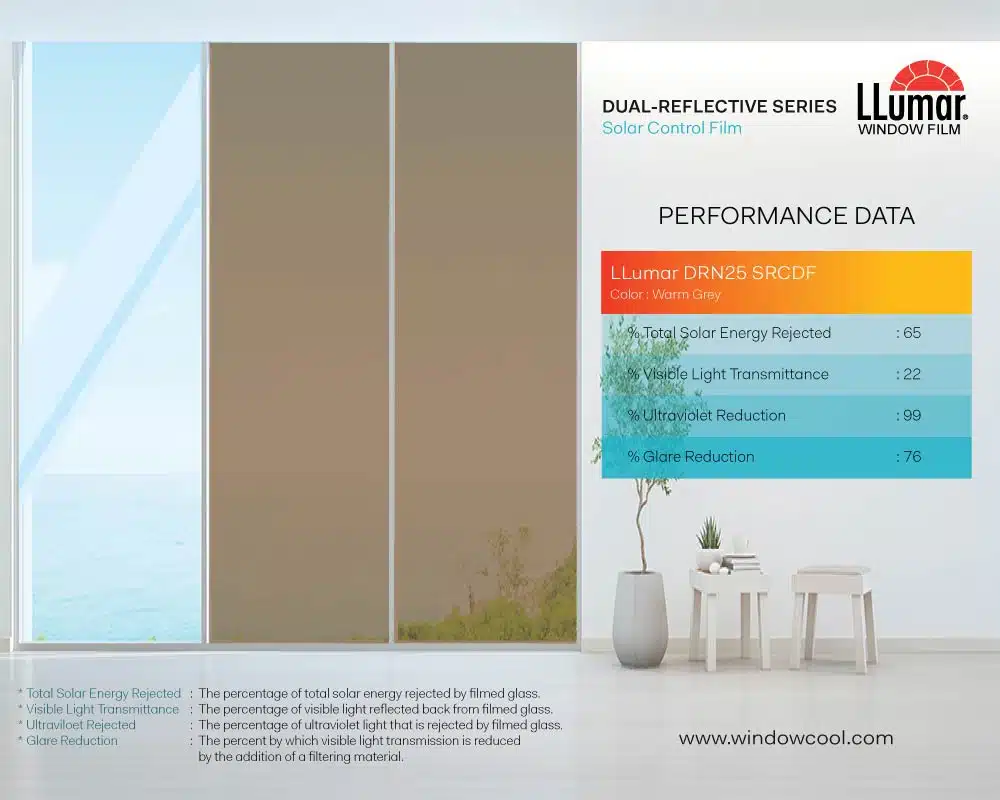
LLumar DRN25 Dual-Reflective Series
LLumar DRN25SRCDF Performance Data
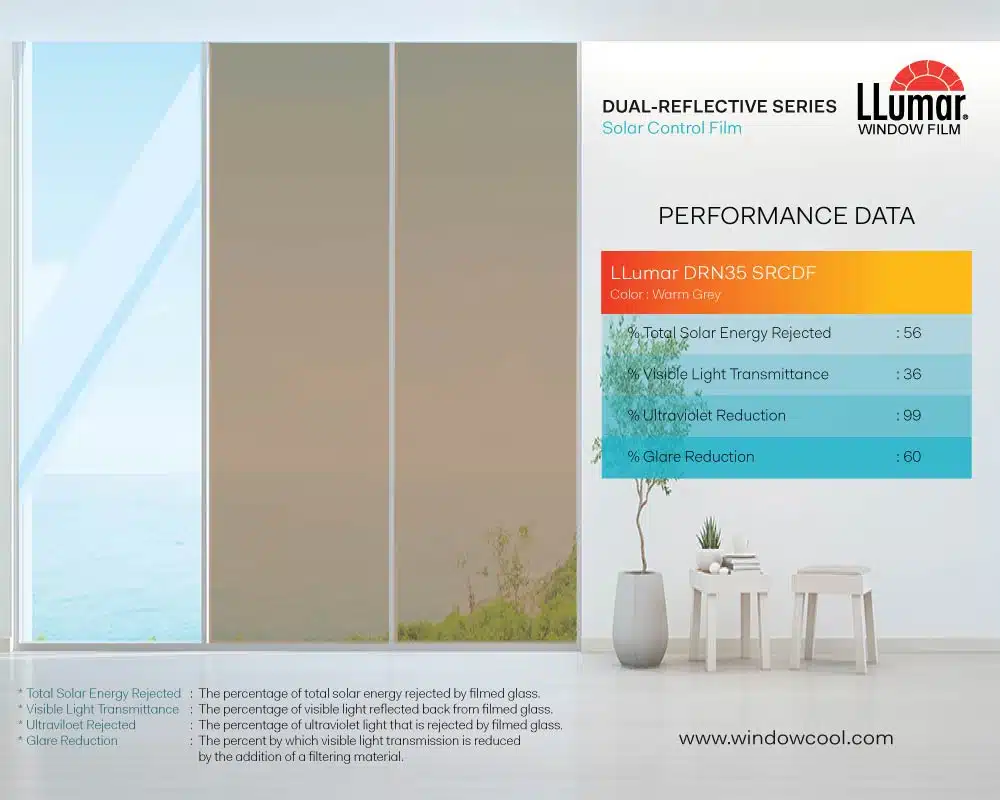
LLumar DRN35 Dual-Reflective Series
LLumar DRN35SRCDF Performance Data