

How Different Glass Types Break—and What Happens Afterwards
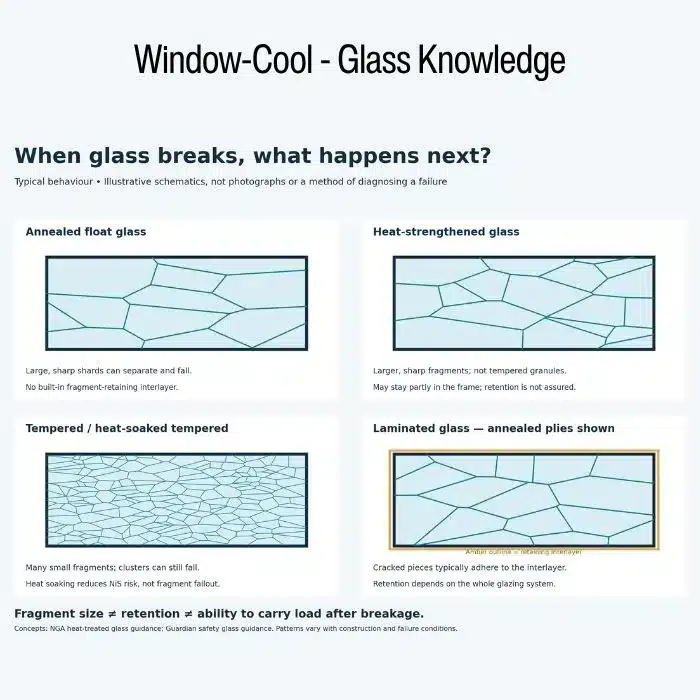
Glass does not have one universal breakage pattern. Annealed glass can form large, sharp shards. Heat-strengthened glass generally produces relatively large fragments, while tempered glass usually breaks into many smaller pieces. In laminated glass, fragments typically remain bonded to an interlayer. Double glazing, Low-E coatings and decorative finishes do not determine a break pattern by themselves; the underlying glass construction matters.
Two windows can look almost identical and behave very differently when damaged.
One may leave sharp fragments projecting from its frame. Another may release smaller pieces onto the area below. A third may appear to remain together because its broken glass is attached to an interlayer.
For homeowners, MCSTs and facilities managers, understanding these differences helps answer three questions:
• How resistant is the glass to breaking?
• What happens to the fragments?
• What continues to support the damaged panel?
These are separate considerations. A pane that is harder to break does not necessarily offer better fragment retention after failure.

Why glass breakage matters in Singapore buildings
In a high-rise condominium, HDB flat or commercial building, the consequences of glass failure depend on its location.
Fragments from a façade panel may fall towards occupied areas. A broken window may leave an exposed opening. Overhead glazing introduces a different concern from a ground-floor partition, even when the glass looks similar.
Solar heating, partial shading, wind pressure, edge condition and installation details also influence the assessment. Glass type is an important starting point, but it is only part of the glazing system. Thermal-stress guidance similarly considers exposure, shading and surrounding conditions together.
Before choosing a film retrofit, establish both the existing construction and the outcome the proposed treatment needs to achieve.
Glass names describe different features
“Tempered,” “laminated,” “double-glazed” and “Low-E” are not mutually exclusive categories.
A window can combine a tempered outer pane, a Low-E coating, a sealed cavity and a laminated inner leaf.
Description | What it tells you |
Float | How the base glass was manufactured |
Annealed | Glass that has not subsequently been heat-strengthened or tempered |
Heat-strengthened or tempered | The glass’s heat treatment |
Heat-soaked tempered | Tempered glass subjected to an additional screening process |
Laminated | Glass plies bonded together through interlayers |
Double or triple glazing | Glazing leaves separated by sealed cavities |
Low-E | A low-emissivity coating characteristic |
Art or decorative glass | An appearance or decorative construction requiring further specification |
This is why “Low-E glass” or “double glass” alone is insufficient information for a detailed retrofit recommendation. The treatment, layers, coatings and support must be understood together.
How the main glass types behave when broken
The table describes typical behaviour. Actual fragmentation and retention depend on construction, dimensions, edge condition, damage, loading and support.
Glass type or construction | Typical breakage behaviour | What matters afterwards |
Annealed float glass | Large, sharp shards can form | Pieces may separate and fall |
Heat-strengthened glass | Relatively large, sharp fragments | Some glass may remain in the frame, but retention is not assured |
Tempered glass | Extensive fragmentation into smaller pieces | Fragments or clusters can fall and leave an opening |
Heat-soaked tempered glass | Same general fragmentation as tempered glass | Heat soaking adds no retaining interlayer |
Two-ply laminated glass | One or both plies may fracture; fragments tend to adhere to the interlayer | Ply treatment, interlayer and support affect the result |
Three-ply laminated glass | Different plies may fracture at different stages | Layer count alone does not establish a performance rating |
Double-glazed unit | Each leaf breaks according to its construction | The sealed cavity does not bond fragments across the gap |
Triple-glazed unit | Each of three leaves has its own breakage behaviour | Three separated leaves are different from three bonded plies |
Low-E glass | Follows the underlying glass construction | The coating does not create a unique safety break pattern |
Decorative or art glass | Varies with substrate and processing | Appearance alone cannot establish safety performance |
The distinction between fragmentation, lamination and insulating construction is supported by glass-industry and manufacturer guidance.
Illustrative schematics, not photographs or test results. Breakage appearance alone does not establish the cause of a failure.
1. Annealed float glass: large shards can remain or fall
Float describes how the base glass is manufactured. Annealed describes glass that has not subsequently been heat-strengthened or tempered.
In everyday quotations, “ordinary float glass” often means annealed float glass. However, float glass can undergo further processing, so its final treatment should be confirmed.
A broken annealed pane can produce sharp, irregular shards. Some may remain lodged in the frame while others separate.
Glass remaining in place is not proof that a damaged pane is safe. It may still contain loose fragments or unstable sections.
2. Heat-strengthened glass: increased resistance, larger fragments
Heat strengthening increases resistance to certain mechanical and thermal stresses compared with annealed glass.
However, heat-strengthened glass does not normally fragment into the small pieces associated with fully tempered glass. Its fragments are generally larger and can have sharp edges.
Monolithic heat-strengthened glass should therefore not be treated as safety glazing simply because it has been strengthened. It can form part of a laminated construction, where the interlayer changes how broken pieces are retained.
Cutting, drilling and relevant edge preparation must be planned before heat treatment. The finished pane cannot be resized like annealed stock.
3. Tempered glass: smaller pieces do not eliminate injury risk
Tempered, or toughened, glass usually fragments into numerous smaller pieces.
This reduces some severe cutting and piercing hazards compared with annealed glass. Nevertheless, fragments can still injure, particularly when they fall from height or remain in clusters.
Failure can also leave an opening where a complete pane previously stood. For this reason, an assessment should consider both falling fragments and the consequences of losing the pane.
The relevant question is not simply whether the glass is tempered. It is whether the complete installation addresses the consequences of its failure.
4. Heat-soaked tempered glass: what changes and what does not?
Heat soaking is an additional screening process applied to tempered glass. It encourages susceptible panes to fail before installation, reducing later breakage associated with certain inclusions, particularly nickel sulphide.
A pane that passes remains tempered glass.
Heat soaking does not add an interlayer, eliminate every failure mechanism or guarantee that fragments will remain in the frame.
Heat soaking reduces a particular breakage risk. Fragment retention is a separate requirement.
5. Two-ply laminated glass: bonded layers help retain fragments
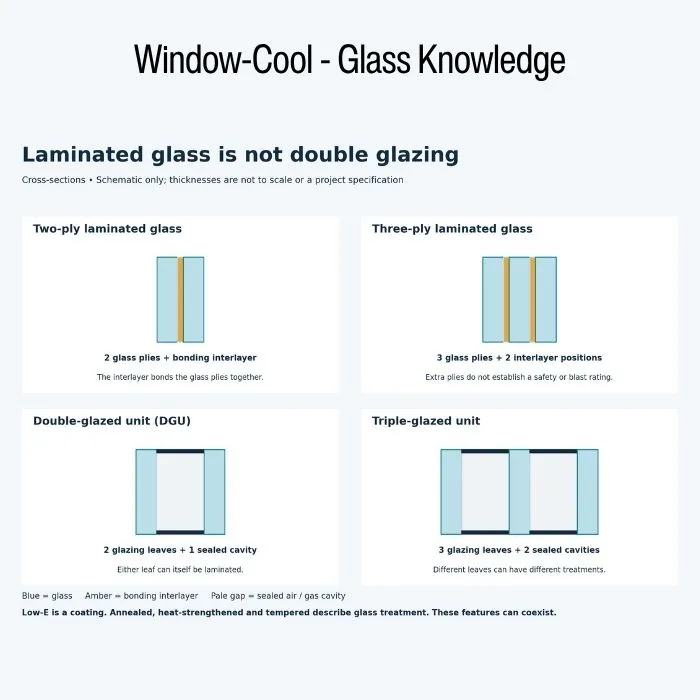
Two-ply laminated glass consists of two glass plies bonded through an interlayer.
If one or both plies fracture, broken pieces typically remain attached to that interlayer. However, the fracture pattern still depends on the glass treatment: annealed laminated glass and tempered laminated glass do not break identically.
“Two-ply laminated” is clearer than “laminated dual-pane,” because dual-pane commonly refers to double glazing.
A useful laminated-glass specification identifies:
• Each glass ply’s thickness and treatment.
• The interlayer type and thickness.
• Panel dimensions and supporting arrangement.
• The performance required from the finished assembly.
The word “laminated” alone does not establish the load a damaged panel can carry or how long it will remain supported.
6. Three-ply laminated glass: more layers need a defined purpose
Three-ply laminated glass contains three glass plies with interlayers between adjacent plies.
It is different from triple glazing, where the glazing leaves are separated by cavities.
Research on multi-layer laminated glass demonstrates that plies can fracture progressively under particular loading conditions. Performance therefore needs to be evaluated for the actual construction and intended use.
Three plies do not automatically establish blast resistance, ballistic resistance or suitability for a barrier.
Where a specific protection level is required, the assessment must consider the assembly, loading, support and relevant evidence—not layer count alone.
7. DGU and triple glazing: identify every glazing leaf
A double-glazed unit, or DGU, contains two glazing leaves separated by a sealed air or gas cavity. Triple glazing contains three leaves and two cavities.
A leaf may itself be laminated, and the different leaves may have different treatments. Consequently, the outside and inside glass can behave differently during failure.
For film planning, this creates an important limitation:
Film on the room-facing surface does not directly bond fragments of a separate outside pane across the cavity.
Consider an illustrative example: a DGU has a tempered outer pane and a laminated inner leaf. A proposal to treat the room-facing surface must not be described as directly retaining fragments of the outer tempered pane.
The first questions are therefore: which pane presents the concern, and which surface will the film treat?
Laminated glass contains bonded plies. Double and triple glazing contain cavity-separated leaves. A leaf within an insulating unit may itself be laminated.
8. Low-E glass: the coating does not define fragmentation
Low-E means low emissivity. It describes a coating that influences heat transfer, rather than a particular glass treatment or breakage pattern.
Coating position also varies. Many coatings are located within an insulating-glass cavity, while some products use a room-facing surface.
Before recommending film, the available information should establish the glass build-up, coating details and proposed application surface.
“Low-E” alone is insufficient to approve or reject a retrofit. Equally, an unknown coating should not be treated as though its compatibility has already been established.
9. Art and decorative glass: verify the construction behind the appearance
Art glass may include stained, patterned, etched or printed glass, as well as decorative materials incorporated into laminated panels.
These descriptions do not identify one safety performance.
For example, selected patterned-glass products are available in toughened or laminated forms. Their appearance alone does not reveal the treatment used.
Film suitability also depends on the proposed bonding surface. A textured, painted or assembled decorative panel should not automatically be treated like smooth, uncoated window glass.
Other glass descriptions that need clarification
Tinted and reflective glass: Colour and reflectivity do not establish fragmentation behaviour. Absorption, exposure and shading also matter when assessing thermal stress.
Wired glass: Visible wire is not sufficient evidence of an impact-safety or fire rating. Pilkington’s specific Texture Glass Wired product, for example, is listed without either rating. Verify the exact product.
Fritted and spandrel glass: These terms describe surface treatment or façade application, rather than the full construction. Heat build-up and surrounding materials require consideration.
Fire-rated glazing: Any proposed film must be checked against the particular glazing system and manufacturer’s requirements. A general film recommendation does not establish approval for a fire-rated assembly.
What should be checked before choosing safety film?
A useful assessment separates the possible cause of failure from the protection required afterwards.
Impact, edge damage, uneven heating and installation stresses may all be relevant. The presence of existing film does not prove that film caused a failure. Similarly, a photograph can support an investigation without establishing the cause on its own.
Next, define the desired outcome. Holding fragments together, retaining a broken sheet within its opening and carrying a specified load are different requirements.
Finally, establish which evidence applies. LLumar’s published test-document index distinguishes glass constructions and attachment configurations. A film name or thickness is therefore not a universal performance rating.
For HDB flats, check HDB’s applicable window-film requirements, including its published reflectance limit. For condominiums, confirm the development’s façade and renovation requirements with the managing agent or MCST. HDB’s guidance specifies non-reflective film or film not exceeding 20% reflectance.
Overhead glazing, barriers and other safety-critical applications need appropriate professional review.
What can safety film do if glass breaks?
Safety film bonds to the glass surface and can help hold broken fragments together, reducing scattering. This is different from preventing the glass from breaking.
Where the objective includes keeping damaged glazing within its opening, the assessment must also address the edges, frame and any required attachment system.
Film is not a repair for cracked glass, a failed sealed unit or deteriorated laminated glass.
If a pane is already broken, keep people away and arrange professional attention. Do not press the glass or attempt to apply film as a repair.
Start with the glass information—not the film thickness
Before recommending film, Window-Cool reviews the available glass information and identifies where further verification is needed.
For an initial discussion, provide:
• An overall photograph taken from a safe position.
• The panel’s location and approximate dimensions.
• Any glass schedule, specification or visible marking.
• Details of existing coatings, film or deterioration.
• The concern to be addressed: heat, glare, injury, falling fragments or a specified security requirement.
If the construction is unknown, say so. Identifying missing information is part of the assessment.
Window-Cool’s published company credentials include BCA registration, ISO 9001 certification and bizSAFE Level 4 status. These support its company and management processes; technical recommendations must still address the actual glazing and relevant evidence.
Contact Window-Cool to discuss whether your existing glass is suitable for a film assessment and what information is needed before a recommendation.
Practical questions before an assessment
What if I do not know my glass type?
Start with available drawings, specifications, invoices or markings. Building management or the original glazing contractor may have useful records. Do not identify the construction from appearance alone.
Can two similar-looking windows require different recommendations?
Yes. Their glass treatments, coatings, dimensions, shading, condition and supporting arrangements may differ.
Should film always be the next step?
No. Depending on the findings, the appropriate next step may be further verification, investigation of a defect, a film assessment or advice on replacement glazing. The recommendation should follow the condition and purpose of the window.
Our Location:
- 50 Serangoon North Ave. 4 #03-03 First Centre, Singapore 555856
Opening Hours:
- Mon - Sat: 9a.m. - 6p.m. PH & Sunday: Closed
WhatsApp Hotline:

The Leading Provider of Window Films & Blinds in Singapore Since 1999
© Copyright 2026 windowcool.com